In this Issue: 
Events and Announcements
- NC Organic Crop Conference will be held on Friday, January 19 at the Riverfront Conference Center in New Bern (at the end of the Joint Corn, Wheat, Soybean Grower Conference). The conference will be an all-day event with a trade show, keynote speaker, and programs on production issues for organic grain, tobacco, dairy, and vegetable farmers. If interested in participating, please contact Sharon Funderburk at coney@mindspring.com or 919357-6273.
- Southern Sustainable Agriculture Working Group (SSAWG) Annual Conference, January 20-23, 2010 at the Chattanooga Convention Center in Chattanooga, TN. For more details go to: www.ssawg.org
- We, at NCSU, are developing an Organic Farm Directory for the state which can be used by anyone and will be based on-line. Farmers can enter information on a web page and their farm will be listed in the on-line directory. This directory can then be used as a connection tool for farmers, organic buyers, and amendment suppliers. To enter your farm information into the directory, go to www.organicgrains.ncsu.edu. The link to the directory form is at the bottom right. If you have any questions or suggestions, please contact Molly Hamilton (molly_hamilton@ncsu.edu or 828-273-1041).
NEW PROJECT: Organic Crop Breeding
By George Place
The need for organically adapted varieties has come up time and again as an important production issue among NC organic farmers and advisors. In the spring of 2009 NCSU was awarded a $1.2 million grant for the development of field crop varieties specifically selected for organic production.
Currently, the overwhelming majority of breeding is done by private industry with the use of pesticides, and for corn and soybeans with transgenic technology. Pest management challenges specific to organic production are not addressed in these breeding protocols. Organic producers are often pressured to use varieties inappropriate for the Southeastern climate or pest populations because of limited seed options permitted under organic certification guidelines. As public breeding efforts continue to shrink while private breeding and use of patented genes expand, available germplasm for organic producers or even non-GMO producers is limited and often outdated. There is a great need to expand public breeding programs to address the regional needs of non-GMO and organic producers in the Southeast USA. Farmers that assisted in the development of this organic breeding project have identified several limitations to currently available varieties for organic production of soybean, corn, wheat and peanut.
This new project, Breeding for Organic Production Systems, will release new varieties of corn, soybeans, wheat, and peanuts by 2012, and seek to develop a dialogue between plant breeders and farmers and their advisors. Breeders will expand their field trial programs to include multiple organic sites on working organic farms. Breeders and farmers can make a realistic assessment of how new breeding lines will perform under actual organic conditions.
This project will also initiate an annual event that will bring together a coalition of plant breeders and organic farmers from around the Southeast. In addition, crop breeders, organic producers, Extension, and researchers will come together to focus on organic crop breeding at the Southern Sustainable Agriculture Working Group (Southern SAWG) meeting. Southern SAWG is an organization dedicated to regional approaches to sustainable agriculture. It holds an annual January event as a forum to build networks between producers and researchers. The 2010 Southern SAWG Conference will be held in Chattanooga, TN on January 20-23. The Breeding for Organic Production Systems meeting will be held on Sunday, January 24 from 8 a.m. to 3 p.m. at the Marriot Plaza A. To register for this meeting, contact Sally Lee at sally@rafiusa.org.
No-till Project Update
by: Carrie Brinton
LEGUMES
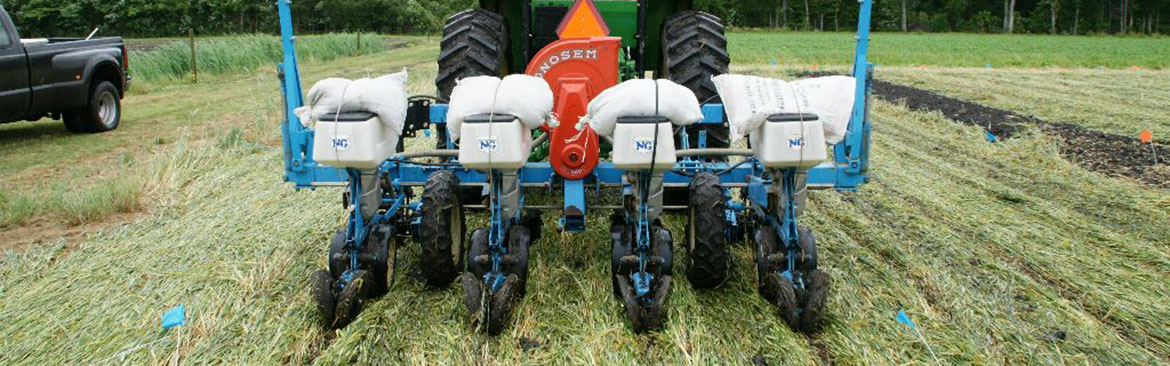
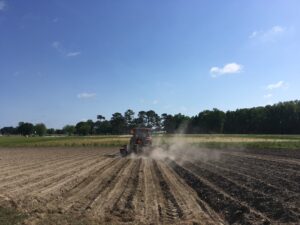
In fall 2008, we planted 14 legume varieties, including berseem clover, subterranean clover, sweet clover, crimson clover, hairy vetch, common vetch, winter pea and blue lupine. This study was planted at Piedmont and Tidewater Research Stations, as well as four farms from Tyner to Mt. Ulla, NC. Each farm was kind enough to host a field gathering one evening during planting season to allow people to see the no-till/roll kill technique early in the growing season. At both research stations we had 3 roll dates at 2-week intervals to roll-kill each cover crop and immediately plant corn (AgVenture AV 8262, 110-112 day maturity) into the mulch. The various roll dates were conducted to assess variety maturity and susceptibility to kill at the time of corn planting. Our 1st roll date occurred mid-April, where none of the cover crop varieties were successfully killed. Our 2nd roll date was early May, which killed the crimson clover varieties, and one hairy vetch – AU Earlycover. We had poor corn stands in the crimson clovers at the Tidewater Research Station for this roll date, presumably due to cutworm. Our 3rd roll date was mid-May, providing kill for another hairy vetch variety – AU Merit. All crimson clovers had completed flowering by this point, and these plots experienced the most reseeding during the summer, although affect on yield has yet to be determined.
Regarding the other varieties, both the sweet and berseem clovers started to flower after we finished planting corn. We were able to get decent corn stands in the last roll date for the berseem clover, but no success with the sweet clover. The subterranean clover died on its own within 2 weeks following the 3rd roll date. Blue lupine was subject to winterkill at all locations. We recently hand harvested the corn and have not finished processing samples, so yield results are not yet available.
In addition to assessing agronomic options in this system, there is additional work being conducted by the Soil Fertility Management in Organic Cropping Systems research group to look at nitrogen availability to the corn crop over the 12 weeks following legume kill. During this first year of the study, this data was gathered on one crimson clover and one hairy vetch variety along with control plots receiving no nitrogen or 150 lb N (as UAN)/A. Preliminary results show that most nitrate from the hairy vetch crop became available to the corn crop between 4 and 6 weeks after roll-kill, but that the crimson clover mulch may have caused some reduced nitrate availability (immobilization) when compared to an unfertilized plot.
RYE
We also looked at this no-till system for rye varieties being rolled and planted into soybean. There were 6 varieties, including both southern and northern. There were 2 roll dates for the rye, immediately planted into soybean (NC Roy, maturity group 6). The 1st roll-kill occurred in mid-May, with the 2nd Regardless of roll date, all rye varieties were killed successfully. We were anticipating the northern varieties to stand back up at the earlier roll date, based on observations from similar planting dates during the previous year, however this did not occur. As of early September, pod set at both research stations looks great.
Meet the Graduate Students
Mary Parr is a second year Master’s student working with Dr. Julie Grossman’s lab studying soil fertility as part of the larger NRCS/CIG-sponsored project looking at organic grain production using innovative cover crop management techniques. Mary’s Masters research will quantify nitrogen fixation in several winter annual legume cover crops including hairy vetch, crimson clover, berseem clover, subterranean clover, lupine, and Austrian winter pea. She is then tracking the release of that N back into the soil after the cover crop is roll-killed. Her research sites are located throughout the state, including the Tidewater Research Station in Plymouth, the Piedmont Research Station in Salisbury, and she will add a site in Kinston this fall. She hopes that this work will result in information that will help North Carolina’s organic growers choose the best cover crops for the needs of their systems.
Adam Smith, from Wilson, NC, started in Master’s program with Drs. Chris Reberg-Horton and Paul Mueller in 2007. For the past two years at NCSU, Adam has worked to create and test better ways to grow organic soybeans with minimum tillage. He killed rye cover crops using either a roller-crimper or a flail-mower. This created a thick “mat” of rye that suppressed weeds. Soybeans were planted into the rye mulch and additional weed control tactics were tested. Adam applied granulated corn gluten meal as an in-row pre-emergent organic herbicide, clove oil as an in-row post-emergent organic herbicide, or used a high-residue between-row cultivator. Results concluded that rye biomass levels higher than 6000 lbs/ac can provide sufficient weed suppression when rolled and crimped. Clove oil provided some additional control, while corn gluten meal increased weed populations by acting as a fertilizer. 2008 yield data showed organic soybeans on par with conventional check plots at two of the three sites. This year’s sites will be harvested in the fall. Adam currently lives in VA, with intentions to start a PhD position at Virginia Tech in organic weed management.
Aaron Fox (Ph.D. Student in Crop Science): How do field borders effect weeds? The USDA Natural Resources Conservation Service currently offers funding to farmers to turn field borders into quail habitat --- could these habitats also help manage agronomic weeds? Small mammals and insects that are known to eat weed seeds may be more abundant in crop-fields that border these habitats. Aaron is looking at four different field border types (1. fallow vegetation, 2. mowed, 3. native prairie forbs/flowers, and 3. a prairie forbs and grasses mix) to find-out if weed seed predators can be integrated into organic weed management strategies. Stay tuned!
George Place has been a part of the organic grains research/extension team since January of 2007 when he began a PhD program in Crop Science. George’s research has focused on alternative weed management in soybean and peanut. His initial projects investigated the effectiveness of various practices in weed control including: pre and post-plant use of the rotary hoe in soybean, use of higher soybean seeding rates, soybean seed size grading, and planting row pattern in peanut. George also worked with the USDA soybean breeding program to investigate differences in advanced soybean lines and popular cultivars in their ability to compete with weeds. George will graduate this December and continue to work with the organic grains program as a research associate, coordinating the efforts of a $1.2 million grant dedicated to crop breeding for organic soybean, corn, wheat, and peanut production.
Carrie Brinton has been working as a research technician with Dr. Chris Reberg-Horton since 2008, and recently began working towards a PhD on the No-till/Roll-kill project. She is evaluating cover crop varieties to determine which work best in NC with the no-till/roll-kill technique in organic production (see article above).
|